

Vinyl flooring has come a long way from the rolled sheet vinyl your grandparents had in the laundry. The 2026 product range covers three distinct categories — luxury vinyl plank (LVP), luxury vinyl tile (LVT), and sheet vinyl — and each one suits a different room and a different budget. This review covers what’s in each, what to look for on the spec sheet, where it works, and where you’d pick something else. For a wider view of waterproof flooring options, see our pillar guide.
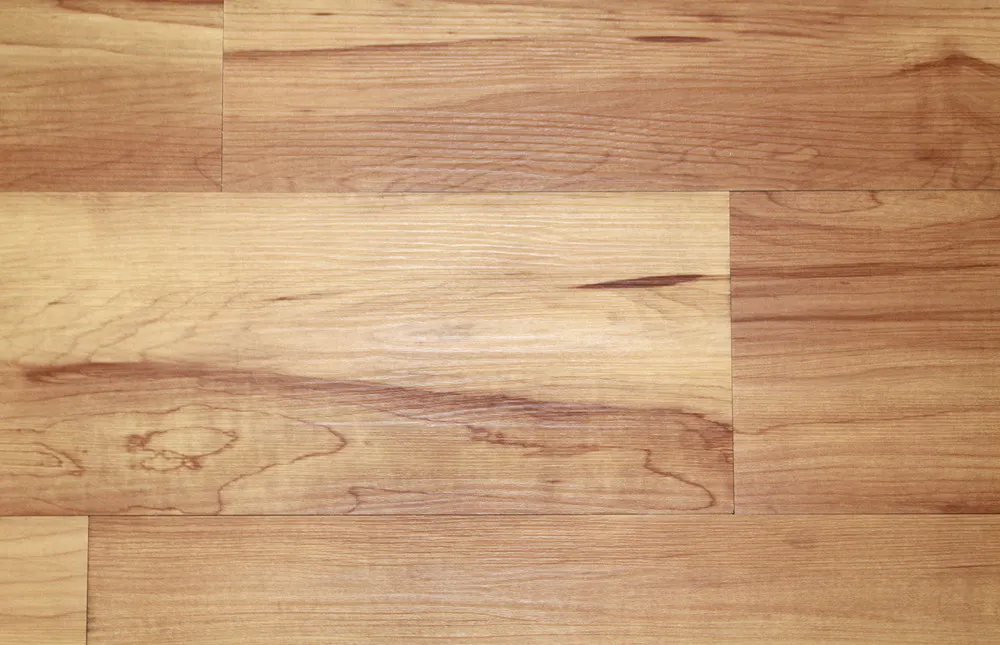
The three types of vinyl flooring
LVP — luxury vinyl plank
LVP is the format that looks like timber. Long planks, typically 1200-1800 mm by 180-220 mm, with a printed timber-look wear layer and either a click-lock or glue-down install. It’s the most common pick for living areas and the one most buyers mean when they say “vinyl flooring” today.
LVT — luxury vinyl tile
LVT is the same construction as LVP but in a tile shape, typically printed to look like stone, terrazzo, or ceramic. Square or rectangular tiles, usually glue-down. It’s a good answer when you want the wet-room practicality of vinyl but the look of a tiled floor — bathrooms, entryways, sometimes kitchens.
Sheet vinyl
Sheet vinyl is the original — large rolls, typically 2 m or 4 m wide, fully bonded to the subfloor. The big advantage is that there are almost no seams, which makes it the most water-resistant vinyl format you can buy. The trade-off is the look (it doesn’t replicate timber as convincingly as a printed plank) and the fact that you can’t replace one damaged area without redoing the whole floor.
How LVP and LVT are constructed
An LVP or LVT plank is a sandwich. From top to bottom, you’re looking at:
- Wear layer: a clear urethane or aluminium-oxide top coat that takes the abuse — claws, grit, dropped pans.
- Print film: the photo-realistic timber or stone image.
- Core: either flexible PVC (traditional LVP), WPC (wood polymer composite), or SPC (stone polymer composite). SPC is the rigid, fully waterproof core most quality vinyl uses in 2026.
- Backing / underlay: often pre-attached IXPE acoustic foam, which means you don’t always need a separate underlay. Whether you do depends on the subfloor and the body-corporate spec — see our note on do you need underlay for vinyl flooring.
Wear-layer thickness — the spec that matters most
If you only check one number on the spec sheet, make it the wear layer. It’s measured in mil (one-thousandth of an inch) or microns. Rough guide for Australian residential use:
- 0.1-0.2 mm (4-8 mil): light residential. Bedrooms, low-traffic. Won’t last in a kitchen.
- 0.3 mm (12 mil): general residential. Good for most homes — kitchens, living areas, hallways.
- 0.5 mm (20 mil): heavy residential or light commercial. The level we’d recommend for households with dogs, kids, or a busy entry.
- 0.7 mm (28 mil) and above: commercial. Overkill for a home but worth it if you’re flooring a rental or a holiday property.
A thicker plank overall doesn’t always mean a thicker wear layer. We’ve seen 5 mm planks with a 0.3 mm wear layer outperform 8 mm planks with a 0.2 mm wear layer in real homes — the surface is what takes the wear, not the core.
Pros and cons
What vinyl does well: it’s waterproof end-to-end (with an SPC core), it’s softer underfoot than tile, it’s quieter than laminate, and a click-lock LVP can be DIY-installed by a confident homeowner. Replacement is plank-by-plank rather than whole-floor. Pricing sits well under engineered timber, with the look getting closer every year.
Where it falls short: a vinyl plank is still a printed surface, and under direct sunlight you’ll occasionally spot pattern repeats across a large area. SPC is hard, so if acoustic comfort upstairs matters you may need a thicker underlay. The print can also fade in north-facing rooms with no UV protection on the windows. And vinyl doesn’t add resale value the way real timber does.
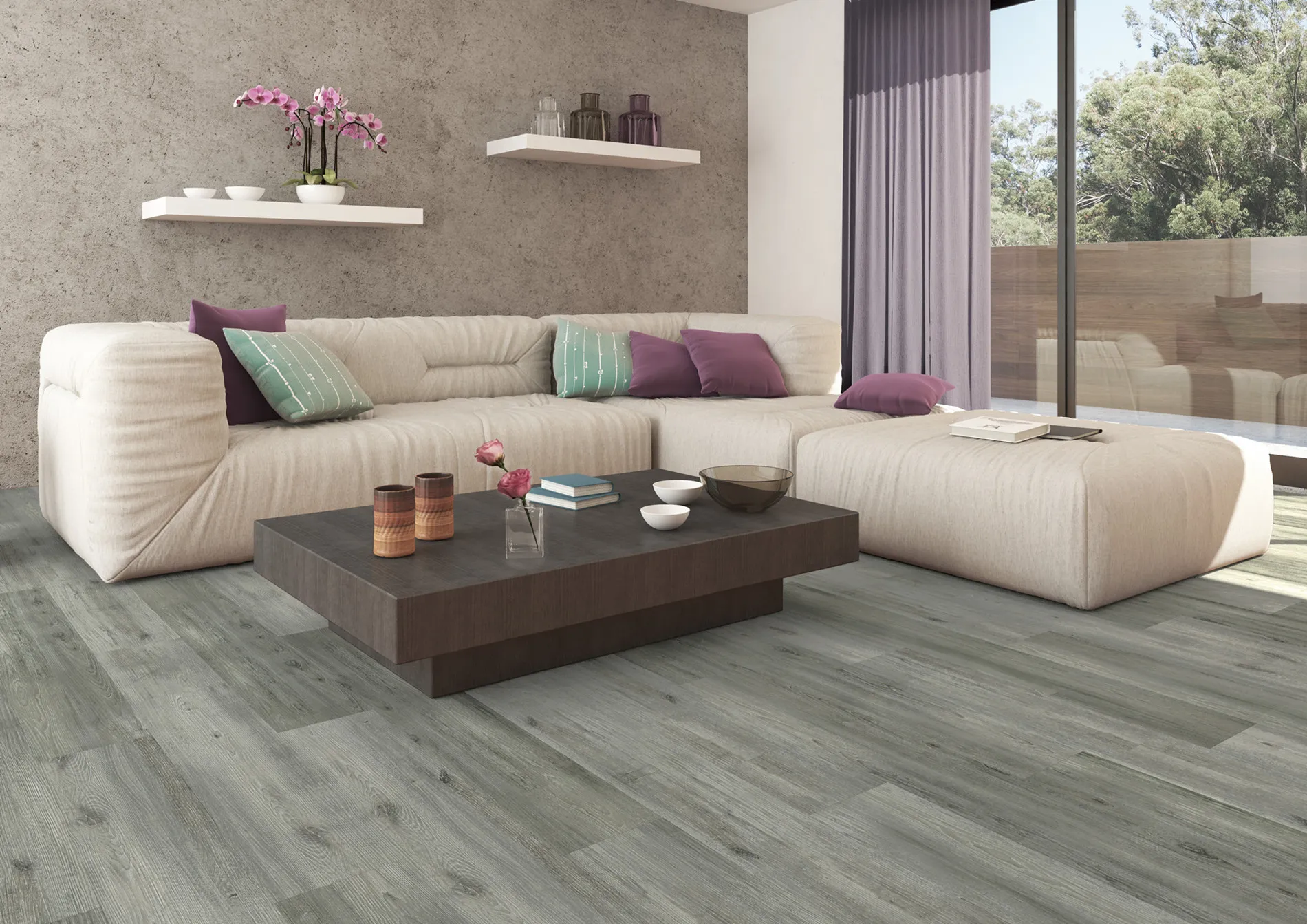
Room-by-room fit
- Kitchen: SPC LVP with a 0.5 mm wear layer. Handles dropped pans, pet bowls, the daily traffic.
- Living and dining: any quality LVP with at least 0.3 mm wear layer. Larger plank format reads more upmarket.
- Bedrooms: the lightest spec you’re comfortable with — a 0.2 mm wear layer is usually fine here.
- Bathrooms: sheet vinyl or LVT with sealed perimeter. Click-lock LVP works only if the silicone seal at every wall is done properly.
- Laundry: SPC LVP or sheet vinyl. Both are fine; sheet wins on cost.
- Pet households: SPC LVP with 0.5 mm wear layer. We’ve covered the detail in is vinyl flooring pee-proof.
Vinyl flooring cost in Australia, 2026
Material-only ranges, supplied through a flooring retailer rather than a hardware chain:
- Entry-level LVP (0.2 mm wear layer): $25-$40 per m².
- Mid-range SPC LVP (0.3-0.5 mm wear layer): $45-$75 per m².
- Premium LVP / designer ranges: $80-$120 per m².
- LVT (stone-look tile): $50-$95 per m².
- Sheet vinyl: $25-$60 per m².
Installation typically adds $25-$50 per m² depending on subfloor prep, demolition, and how square the room is. A laundry over a flat slab is the cheap end; an upstairs bedroom over old carpet with skirting board removal sits at the top.
Vinyl vs hybrid, laminate, and engineered timber
- Vinyl vs hybrid: the line has blurred. SPC hybrid is essentially a thicker, more rigid LVP with a heavier wear layer. If you want the most waterproof, dimensionally stable plank in the range, hybrid is the pick. If price matters more, mid-range SPC LVP gets you 90% of the way for less.
- Vinyl vs laminate: laminate has a real wood-fibre core that swells if water reaches it. Vinyl doesn’t. In any wet zone, vinyl wins. In a dry bedroom, laminate is cheaper and can look slightly more authentic.
- Vinyl vs engineered timber: engineered timber is real wood. It costs more, marks more easily, and isn’t waterproof — but it adds resale value and can be sanded back. If timber is the goal and the room is dry, engineered wins. If practicality matters, vinyl wins.
Installation notes for Australian homes
A few things we tell every client before install day:
- Subfloor flatness: 3 mm tolerance over a 2 m span. Anything outside that needs self-levelling. SPC won’t hide undulation and the click joint will eventually pop.
- Moisture barrier on slabs: a polyethylene moisture barrier under the floor is standard practice on ground-floor concrete in Australian conditions, regardless of how dry the slab tests. See our notes on how to lay vinyl on a concrete floor.
- Acclimatisation: 48 hours in the room of install, in the box, before the planks come out. Stops the post-install gapping that’s the most common complaint we troubleshoot.
- Expansion gaps: 8-10 mm at every wall and fixed object. Skirting or scotia covers it.
- Sheet vinyl: always a professional install. Cutting a 4 m roll square in a real-world room is harder than it looks.
Is vinyl flooring worth it in 2026?
For most Australian homes, yes. The combination of waterproofing, durability, and price-point puts it ahead of laminate and tile for whole-of-house flooring, and ahead of engineered timber for any wet zone. The rule we’d give: pick the wear-layer thickness that matches your traffic, get the subfloor right, and use SPC over WPC if you have the budget. Come into our Sydney or Brisbane showroom with a sample of your kitchen joinery and we’ll match it under your light before you commit.
Ready to shop? Browse our full pet-friendly hybrid range online, or drop into our Sydney or Brisbane showroom to see the range in person.