
The short answer: for most engineered timber jobs in Australia, a one-part MS polymer or polyurethane wood-flooring adhesive is the right pick. Bostik Ultraset 2-in-1, Sika SikaBond-54 Wood Floor and Mapei Ultrabond Eco S968 1K are the three products we see used most often on residential installs. The longer answer depends on your subfloor, the moisture in the slab, and the plank size — and getting that decision wrong is what causes cupping, hollow spots and squeaks six months down the track.

The three adhesive families that matter
You’ll see a lot of adhesive jargon on shelves at trade suppliers. For engineered timber on a typical Australian residential slab, the choice really comes down to three chemistries.
MS polymer hybrids (the everyday pick)
MS polymer (modified silane) and silane-terminated polymer adhesives are the workhorses of residential engineered timber. They cure flexibly, bond to porous and non-porous subfloors, and most include a moisture barrier and sound-dampening function in the same trowelled bed — which is why they’re often labelled as “2-in-1” or “3-in-1” products.
- Bostik Ultraset 2-in-1 — adhesive plus moisture barrier, sold in 16 kg pails. Suits most engineered timber up to standard plank widths over a properly prepared concrete slab.
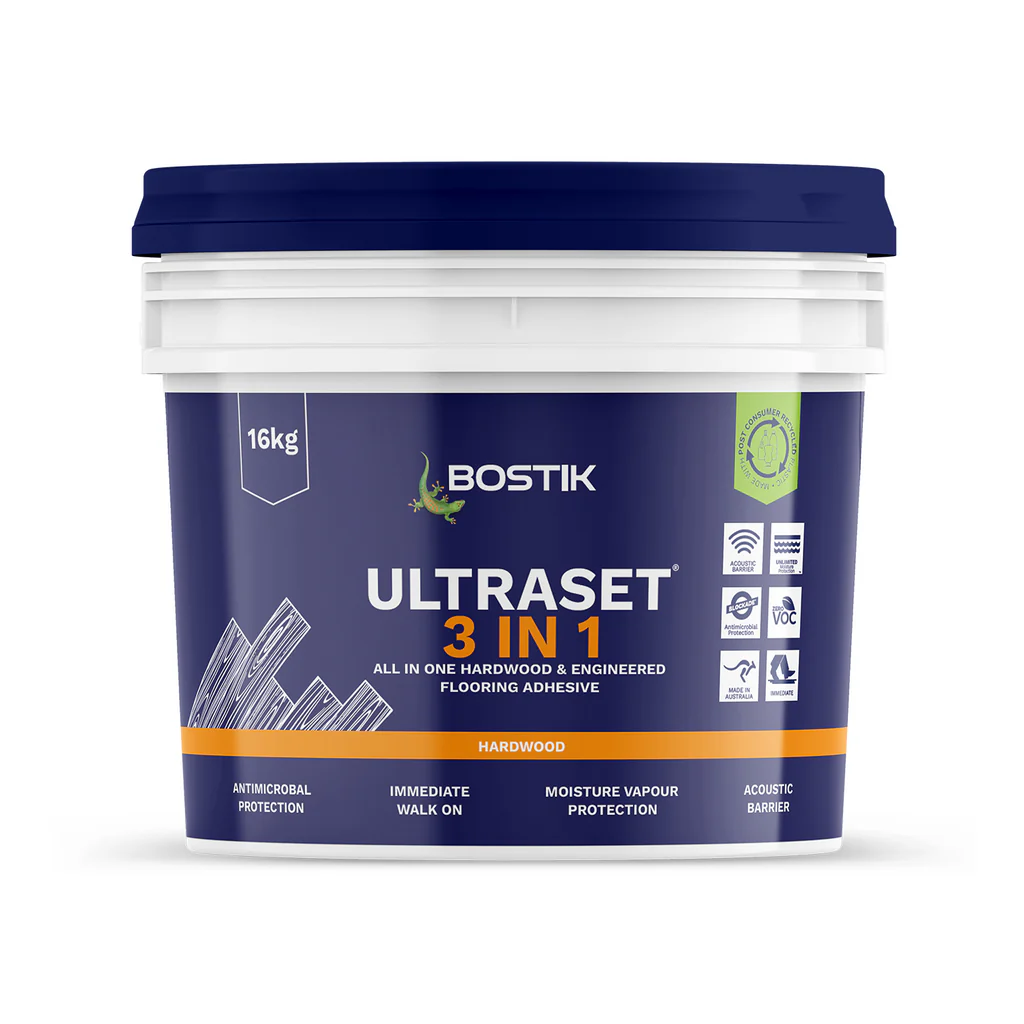
- Bostik Ultraset 3-in-1 — adds an acoustic-dampening function to the same bed. Worth the step up if the floor sits over a habitable room and you want to take some impact-sound transmission out of the build-up.
- Sika SikaBond-54 Wood Floor — single-component elastic adhesive used widely on engineered timber and parquetry. Hard-elastic cure, which keeps the plank firmly down without going brittle.
- Mapei Ultrabond Eco S968 1K — silane-based, very low VOC, common on jobs where indoor air-quality ratings or Green Star compliance matter.
Polyurethane (heavy-duty and wide-plank)
One-part polyurethane adhesives are stiffer and stronger than MS polymer, which makes them the right pick for wide planks (220 mm-plus), parquetry blocks, and jobs over plywood subfloors that need a properly rigid bond. They’re a bit fussier to clean off the surface — wipe smears straight away with a polyurethane cleaner, not a damp rag.
- Bostik Ultraset HP — high-performance one-part polyurethane, sold in 16 kg drums. Used regularly on commercial-grade engineered timber and wider planks.
- Sika SikaBond AT-82 — STP/PU hybrid with a higher shear strength than the standard SikaBond-54, suited to large-format engineered planks.
- Mapei Ultrabond P990 1K — polyurethane, often specified for parquetry and wide-board engineered timber over concrete.
Two-part epoxy (the niche case)
Two-part epoxy systems give the strongest bond and the highest moisture tolerance, but they’re slower to work with and harder to mix on site. For a typical home install you don’t need them. Where they earn their keep is on slabs with elevated residual moisture, on heated subfloors, or on commercial projects where the spec sheet calls for it. If your moisture reading is borderline, a separate epoxy moisture-barrier primer (used under an MS polymer or polyurethane adhesive) is usually a smarter build-up than a full epoxy bed.

Match the adhesive to the subfloor and the plank
The adhesive you choose has to suit two things: what’s underneath the plank and how big the plank is.
- Concrete slab, standard plank (up to ~190 mm wide). An MS polymer 2-in-1 like Bostik Ultraset 2-in-1, Sika SikaBond-54 or Mapei Ultrabond Eco S968 1K is the typical pick. The integrated moisture barrier covers most residential slab readings.
- Concrete slab, wide plank (220 mm-plus) or parquetry. Step up to a polyurethane or higher-shear hybrid: Bostik Ultraset HP, Sika SikaBond AT-82, or Mapei Ultrabond P990 1K.
- Plywood or particleboard subfloor. A flexible MS polymer or polyurethane will both work. Make sure the sheet flooring is screwed (not just nailed) and any seams are flat before you trowel.
- Heated subfloor. Check the adhesive data sheet for an explicit underfloor-heating approval. Most modern Bostik, Sika and Mapei wood-floor adhesives are rated for it; older general-purpose products often aren’t.
- Borderline moisture reading. Prime with a two-part epoxy moisture barrier (e.g. Mapei Eco Prim PU 1K or Sika MB) before the adhesive bed. Don’t try to fix a wet slab with extra adhesive.
Subfloor prep is half the job
The most common adhesive failure we see isn’t the adhesive — it’s the slab. Before you crack a pail open, the subfloor needs to be:
- Flat to within 3 mm over a 2 m straight edge. Anything outside that needs self-levelling compound. High spots will cause hollow points; low spots will cause squeaks once the adhesive cures.
- Clean and sound. Grind off paint, plaster blobs, old adhesive residue, and any laitance on a fresh slab. Vacuum, don’t sweep.
- Dry. Test moisture with a calibrated meter — concrete slab readings should be within the adhesive manufacturer’s stated limit (often given as a relative-humidity percentage or a moisture-content percentage). If you’re over the limit, prime with a moisture-barrier epoxy first.
- Squared and set out. Snap a centre line, dry-lay the first two rows, and check the room is square before you trowel. The 3-4-5 rule for squaring a room is the fastest way to do this without a laser.
Trowel size, coverage and open time
The trowel notch size is what controls how much adhesive ends up under the plank. Too small a notch and you get hollow spots; too large and you get squeeze-up between the joints. As a guide:
- Standard engineered planks: a 4-5 mm V-notch or B3 trowel, giving roughly 1.0-1.2 kg/m² coverage.
- Wide engineered planks (220 mm+) and parquetry: a 5-6 mm B11 trowel, around 1.2-1.5 kg/m².
- Open time: typically 40-60 minutes for MS polymer hybrids and 30-45 minutes for polyurethane, but check the data sheet for the specific product and the day’s temperature. Hot days shorten open time; cool, humid days extend it.
Lift a board after the first ten minutes of work and check the back. You want at least 80% adhesive transfer to the underside of the plank — if it looks patchy, the trowel notch is too small or you’ve been working past the open time.
A few honest mistakes to avoid
- Using a generic construction adhesive. Liquid Nails-style construction adhesives, water-based PVA, and tile adhesive are not engineered-timber adhesives. They’ll fail.
- Skipping the moisture test. Slab moisture is invisible and the most common cause of cupping six months later. Test, don’t assume.
- Mixing chemistries. Don’t double up — for example, gluing the tongue and trowelling a full-spread adhesive. Either full-spread or floating with click-lock joinery, not both.
- Cleaning smears with water. MS polymer and polyurethane both need a dedicated solvent wipe (or methylated spirits in a pinch) within the first few minutes. Once cured, you’ll be sanding it off.
The bottom line
For a standard residential engineered timber install over a sound concrete slab, a one-part MS polymer 2-in-1 or 3-in-1 from Bostik, Sika or Mapei will do the job and give you a moisture barrier in the same trowelled bed. Step up to a polyurethane like Bostik Ultraset HP, Sika SikaBond AT-82 or Mapei Ultrabond P990 1K when the planks are wide or the subfloor is plywood. Use a two-part epoxy primer for borderline moisture, not as the main adhesive. Always prep the slab properly and follow the manufacturer’s data sheet — the right adhesive used the wrong way still fails.
If you want to scope budget around the whole job — adhesive, levelling, install and the timber itself — our engineered timber flooring prices guide breaks down where the dollars go. For homes going down the vinyl or hybrid path on slab instead, the lay vinyl on a concrete floor guide covers the equivalent prep checklist. Drop into our Sydney or Brisbane showroom and we’ll match the adhesive to your floor, slab and plank size in person.
Looking at real timber? Browse the full engineered timber flooring range at The Flooring Guys — oak and Australian species from 12mm to 21mm, with samples available.
Frequently asked questions
For most Australian residential installs, a one-part MS polymer or polyurethane wood-flooring adhesive. Bostik Ultraset 2-in-1, Sika SikaBond-54 Wood Floor and Mapei Ultrabond Eco S968 1K are the products used most often.
No. The adhesive has to suit the subfloor and the slab moisture. Some products include a moisture barrier in the same application; others need a separate primer or membrane first.
Too little adhesive or the wrong notch size leaves hollow spots, which show up as squeaks, cupping and movement six months later. Follow the trowel size and coverage the adhesive maker specifies.