
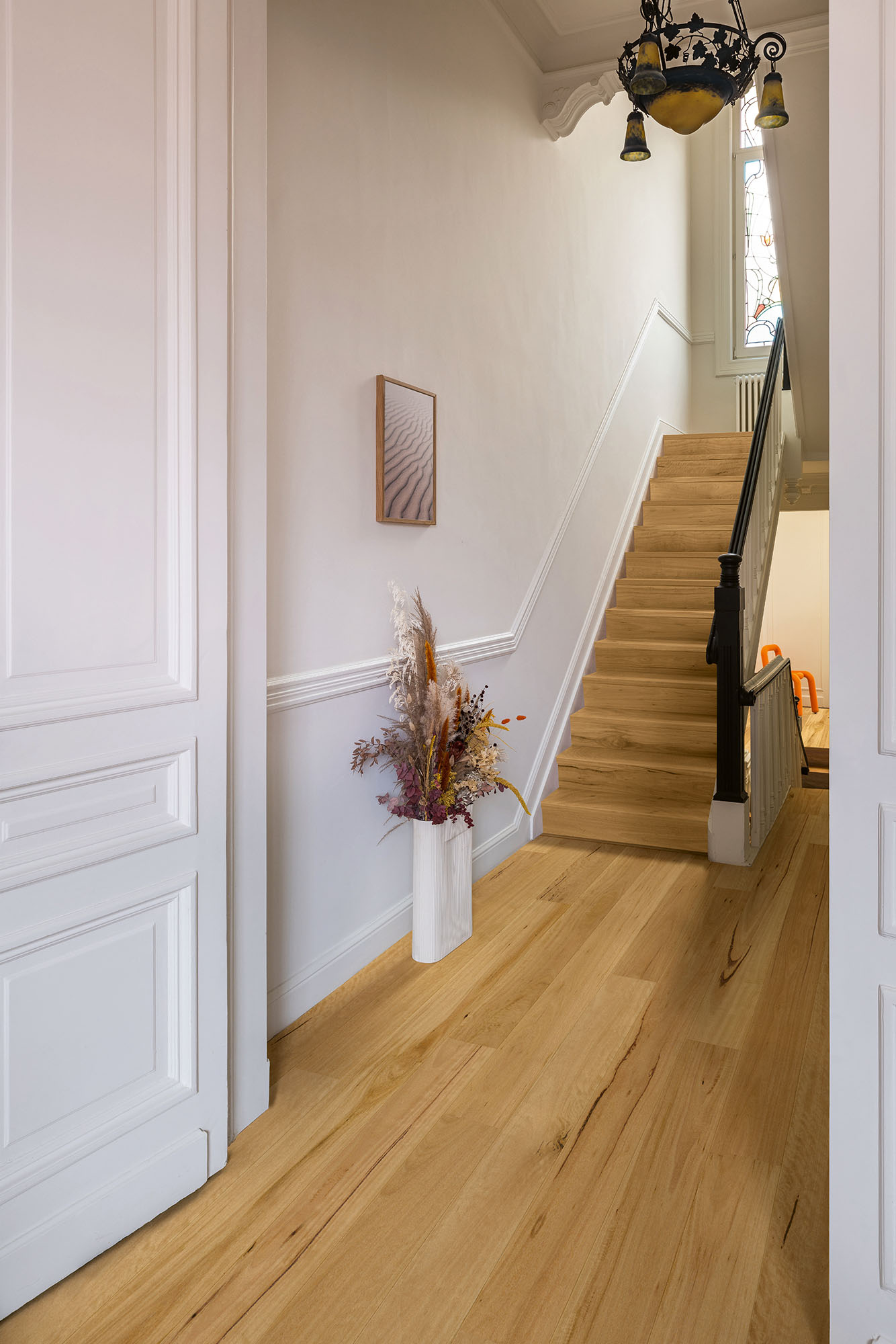
Most engineered hardwood installs in an average Australian home take between 1 and 4 days from the installer arriving to the last skirting going back on. A small bedroom can be done in a day. A full open-plan living area with stairs and tricky cuts can stretch to four. The honest answer depends on five things: room size, install method, the state of your subfloor, whether the boards need to acclimatise, and whether the finish is factory-applied or site-finished.
A realistic day-by-day timeline
For a typical 60-80 m² living and dining area in a Sydney or Brisbane home with a reasonably flat subfloor and pre-finished boards, the schedule usually looks like this:
- Day 0 (acclimatisation): boards delivered and left in the room, in their packs, for 48-72 hours so the timber settles to the home’s humidity. This step happens before the installer’s clock starts but it’s part of the calendar.
- Day 1: furniture moved, old flooring lifted, subfloor checked for level and moisture, any self-levelling compound poured.
- Day 2: install begins. A two-person crew can lay 30-50 m² of straight-pattern engineered hardwood per day on a clean subfloor.
- Day 3: install finishes, scotia or skirting goes back on, transition strips at doorways are fitted.
- Day 4 (only if site-finished): sanding, staining and coating. Most engineered hardwood sold in Australia is pre-finished, so this day is usually skipped.
How install method changes the timeline
Floating (click-lock)
Fastest method. Boards click together over an underlay and aren’t fixed to the subfloor. A two-person crew can comfortably finish a 70 m² living area in a single day if the subfloor is level and the layout is straightforward. Most modern engineered ranges use a 5G or 2G click system that snaps together by hand without tapping blocks, which speeds things up further.
Glue-down
Slower but quieter and more solid underfoot. Each board is troweled into MS-polymer adhesive on the subfloor. Plan on roughly 50 percent more install time than a floating job, plus a curing window before furniture goes back. Glue-down is often the right call over concrete slabs or in upstairs apartments where impact noise to the unit below is a concern.
Nail-down (secret-nail)
Used over a structural plywood or particleboard subfloor — common in older Australian homes with battens over joists. Each board is secret-nailed through the tongue. It’s the slowest of the three and adds about a day to the schedule on a typical project. Nail-down also needs the subfloor checked for squeaks and loose sheets before any flooring goes down.
What can blow the timeline out
The jobs that take longer than the brochure suggests almost always have one of these issues:
- Subfloor isn’t flat. Engineered hardwood needs roughly 3 mm tolerance over a 2 m span. Anything more and the floor will telegraph the dip and the joints can fail. Self-levelling adds half a day to a day, plus a cure time.
- Moisture in the slab. A new concrete slab can take months to dry to the moisture level engineered timber needs. A moisture test on day one tells you whether you can lay or whether you need a moisture barrier first.
- Tricky layouts. Herringbone, chevron and diagonal-pattern installs can double the labour time of a straight-pattern lay. Same for rooms with lots of cuts around kitchen islands, columns or curved walls. The 3-4-5 rule for squaring a room is what good installers use to set out these patterns from a true centre line.
- Stairs. Treads and risers are slow work. Allow half a day per flight on top of the floor install.
- Site-finished boards. If you’ve chosen a raw board to be sanded and oiled or lacquered on site, add 2-3 days for sanding, coating and dry time between coats. Most homeowners go pre-finished to avoid this.
Acclimatisation: the day people forget
Engineered hardwood is real timber on top of a multi-ply core, and timber moves with humidity. Manufacturers specify an acclimatisation period — usually 48-72 hours, sometimes longer for wider boards — where the packs sit in the room they’ll be laid in, with the home’s normal heating, cooling and ventilation running. Skip this and you risk gaps in winter or cupping in summer. We always count acclimatisation in the project calendar even though no installer is on site that day.
When can you walk on it and put furniture back?
Floating floors are walkable immediately. Glue-down typically asks for 24 hours before foot traffic and 48-72 hours before heavy furniture goes back, so the adhesive cures fully. Site-finished floors need around 24 hours per coat for water-based finishes, and you should leave rugs off for at least a week so the finish gases off properly.
The short answer
Plan on 1-4 days of installer time, plus 2-3 days of acclimatisation before they start, plus an extra day or two if you’re going site-finished or laying a herringbone pattern. For an exact estimate on your home, the right move is to have an installer measure up and check the subfloor in person — the difference between a one-day job and a four-day job is usually decided before a single board goes down. We can put you in front of one of our installers across our Sydney and Brisbane showrooms, and our engineered timber flooring prices guide covers what the labour line typically looks like alongside the materials.
Ready to shop? Browse our full engineered timber flooring range online, or drop into our Sydney or Brisbane showroom to see the range in person.